
PROJECTEnquire ↗
← All technologies

Tanks and storage operations

Level measurement and tank inventory

Level, volume, temperature and liquid interfaces answer different operating questions. A suitable system turns them into information that the plant can use.

The whole application matters.

A storage tank may need an individual instrument or a tank-gauging assembly with local indication and a supervisory-system interface. Converting level into inventory requires tank data and, depending on the purpose, temperature, density or pressure measurements.

Alternative level-measurement principlesThree separate alternatives: radar above the surface, a hydrostatic sensor near the bottom and a local level gauge connected to the tank.ALTERNATIVE PRINCIPLESRadarHydrostaticLocallevel gauge
Alternative measurement principles. The method is selected for the medium, tank and operating conditions.

From operating need to design.

01

Continuous level and interfaces

Radar, guided-wave or hydrostatic measurement is selected around vessel geometry and the product. Foam, deposits, agitation and headspace pressure influence performance. Measuring an interface between two liquids requires its own application assessment.
02

Local operating indication

Glass or magnetic level gauges provide a local reading. Connection centres, visible range, materials and access belong in the design. Float selection must take account of liquid density and operating conditions.

03

Inventory and protective functions

Volume calculations require geometry or a tank table. Inventory management, process alarms and overfill protection have different requirements. A shared display does not by itself demonstrate that a protective function has been achieved.

A scope you can specify.

Inputs that matter.

  • Medium, density and any liquid interface.
  • Tank drawing, nozzles and internals.
  • Pressure, temperature, foam and cleaning.
  • Required result and accuracy.
  • Alarms, signals and maintenance access.
  • Existing gauge identification, visible length, connection centres and glass specification when ordering spares.
Prepare your brief →

Outputs and acceptance.

  • Instrument and accessory specification.
  • Installation and inventory-calculation design.
  • Verification plan and connection documents.

The actual scope and acceptance criteria depend on the application and contract.

Selecting level measurement

Tank geometry, fluid properties and process conditions drive selection; process level measurement and overfill protection need specifications appropriate to their different functions.

On a small screen, scroll the table sideways to compare the selection criteria.

Selecting level measurement
Principle or optionTypical applicationWhat to verify when selecting
Non-contact radarContinuous measurement of distance to the surface without an immersed probe.Nozzle and beam alignment, internal obstructions, medium reflectivity, foam, condensation and antenna contamination.[1]
Guided-wave radarLevel measurement along a probe; liquid interfaces where media and configuration permit.Dielectric properties of each layer, probe length and support, buildup, emulsion and measuring limitations near probe ends.[1]
Hydrostatic or differential pressureLiquid column height inferred from pressure near the bottom of a tank.Density and its variation, pressure above the liquid, tap elevations, fouling and temperature effects on a remote-seal assembly.[2]
Magnetic float level indicatorLocal visual level indication using a float in a bypass chamber.Fluid density for the float, pressure and temperature, chamber materials, open connections, and provisions for isolation and cleaning.[3]
Sight-glass level gaugeDirect local level viewing; a transparent design may also reveal colour or a liquid interface.Glass and gasket design for the medium, lighting, deposits, temperature changes and safe maintenance access.[4]
Sources for this comparison
  1. Emerson – Level measurement product and application guide ↗
  2. Endress+Hauser – Level measurement overview ↗
  3. WIKA – BNA bypass level indicator ↗
  4. WIKA – Level measurement brochure ↗

Reviewed on 18 October 2026. Selection is confirmed for the specific operating conditions and equipment design.

From the project portfolio.

All projects ↗
Project photograph.

Project 421 · Measurement & instrumentation

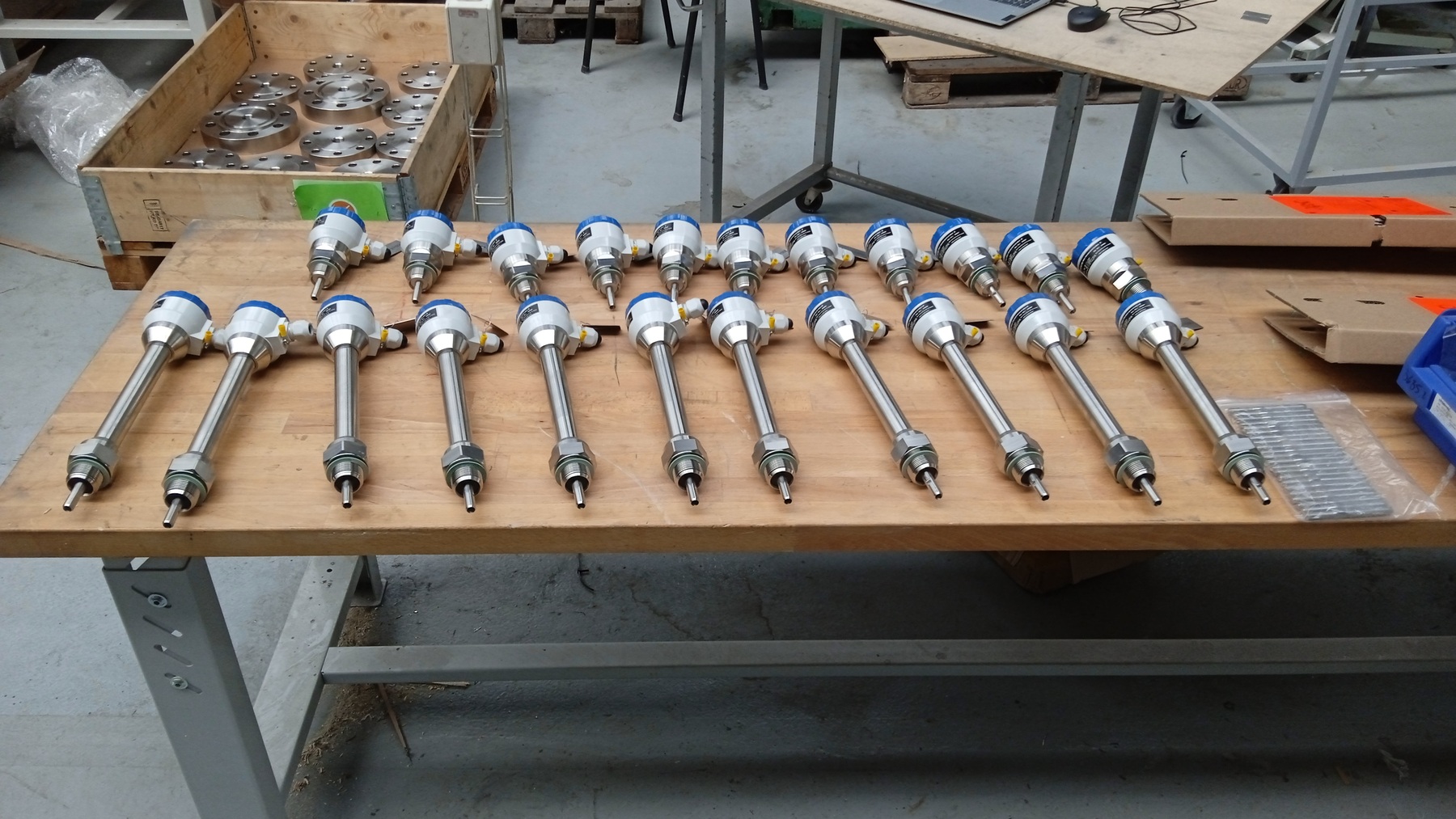
Radar transmitters for isopropanol production

Delivery region: Middle East · 2024

24 guided-wave radar level transmitters for a chemical process, including cable-probe components and flanges.

Broader project portfolioInstrument and component supply

24 radar level transmittersDetails →

Expertise for this application.

Connect the whole solution.

Questions that shape the project.

Can one sensor measure both level and volume?

Volume can be calculated from level when the height-to-volume relationship is known. The quality of that information contributes to the accuracy of the result.

Can existing nozzles be retained?

Often, but their position, bore, spacing and condition must suit the selected principle. Drawing review and a site survey determine what can be reused.

Can only the level-gauge glass be replaced?

After verifying the exact configuration and the condition of the body, joints and seals. Glass type and any protective layer must match the service conditions and manufacturer instructions.

A clear brief.
A practical next step.

Send your drawings, operating parameters or a short description of the change you need. We will review the technical interfaces and propose the next steps towards a quotation, clarifying any missing information with you.

Discuss your requirements ↗Prepare a technical brief →+420 731 771 147info@emkoproject.cz