Control across the operating range
Flow coefficient and characteristic are evaluated at minimum, normal and maximum flow. High differential pressure, cavitation or flashing may require a different construction rather than simply a larger valve.
 PROJECTEnquire ↗
Isolation and flow control
The valve, actuator and controls must perform one defined duty. Selection depends on the process, shut-off requirements, operating mode and response to loss of power.
Operating context
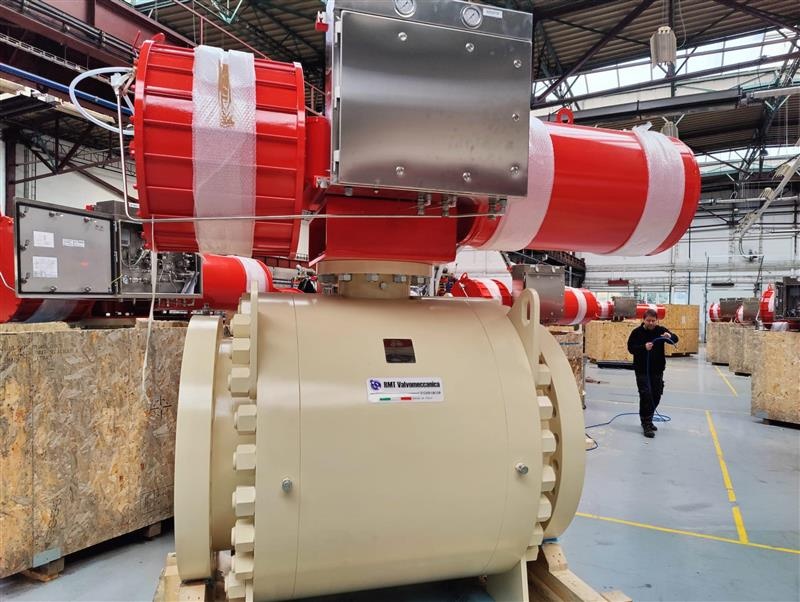
Engineering can cover manual isolation, an actuated assembly or a control valve. Beyond the body and connections, it defines the flow characteristic, actuator force or torque, feedback and control-system interface. Pipe size alone is not enough for selection.
Engineering priorities
Flow coefficient and characteristic are evaluated at minimum, normal and maximum flow. High differential pressure, cavitation or flashing may require a different construction rather than simply a larger valve.
An on/off assembly requires the operating frequency, travel time and behaviour on power failure. The actuator must suit valve loads and environmental conditions, including the available installation space.
Local and remote operation, end positions, fault signals and pneumatic accessories form one interface. Body integrity, seat leakage and actuator function are different acceptance activities that need separate criteria.
The supply can cover a valve, an actuator with accessories or a complete actuated assembly. A retrofit starts with checking valve condition, required torque or thrust, mounting interfaces and clearance. Brackets or adapters, actuator installation, setting and functional testing follow from this assessment.
For storage tanks, we specify pressure and vacuum breathing valves and, where required, in-line or end-of-line flame arresters. Selection considers the medium, filling and emptying, temperature changes and vapour-discharge conditions, including pressure losses and required flow. Flame propagation protection and overpressure protection are assessed separately. These components are not universal substitutes for safety relief valves.
Ball valves are complemented by concentric and triple offset butterfly valves, wedge and knife gate valves, and swing and dual plate check valves. Fibres or solids require review of the flow passage and knife gate design; check valve selection considers flow direction and the piping operating regime.
Supply boundaries
Before engineering
Agreed with the proposal
The actual scope and acceptance criteria depend on the application and contract.
Selection in context
First define control, isolation or reverse-flow prevention, then evaluate the valve, actuator and all operating conditions together.
On a small screen, scroll the table sideways to compare the selection criteria.
| Principle or option | Typical application | What to verify when selecting |
|---|---|---|
| Globe control valve | Continuous flow, pressure or temperature control through an adjustable flow area. | Kv/Cv at operating points, characteristic, cavitation or flashing, noise, shut-off leakage and actuator thrust.[1][2] |
| Ball valve | Quarter-turn pipeline isolation; throttling requires a design intended for control duty. | Bore and pressure loss, seats and seals, torque, cycling frequency and required position on loss of power.[3][2] |
| Butterfly valve | Compact isolation or control where face-to-face length and weight are important. | Design and seat type, permitted differential pressure, disc clearance, shut-off leakage and torque throughout travel.[3][2] |
| Check valve | Automatic reverse-flow prevention, for example on a pump discharge. | Opening conditions, flow range, orientation, pressure loss and response to rapid flow changes.[4] |
Reviewed on 18 October 2026. Selection is confirmed for the specific operating conditions and equipment design.
Relevant experience
Project 116 · Valves & piping
Export project region: Middle East · 2020–2022
150 assemblies in the project scope; 111 in documented completed stages. Pneumatic actuators, functional tests and export packing.
Broader project portfolioStaged valve and actuator supplies
Connected disciplines
Related technologies
Before we start
Not every design is suitable for throttling or continuous control. Suitability must be established for the particular construction and operating conditions.
No. Travel time must respect the process and pressure transients. It is assessed together with the valve and the piping system.
Yes, where its condition and construction are suitable. We check loads, mounting interfaces, clearance and available utilities. The design also defines the required failure position and control-system connection.
Your next project
Send your drawings, operating parameters or a short description of the change you need. We will review the technical interfaces and propose the next steps towards a quotation, clarifying any missing information with you.
Discuss your requirements ↗Prepare a technical brief →+420 731 771 147info@emkoproject.cz