Stable transport of parts and pallets
Dimensions and underside condition influence support and roller spacing. Weight alone is insufficient: centre of gravity, carrier stiffness, overhangs and loading or unloading methods also matter.
 PROJECTEnquire ↗
Material flow between workstations
A conveyor must fit the product, cycle and operator tasks. Belt speed or motor power alone does not describe the capacity of the complete line.
Operating context
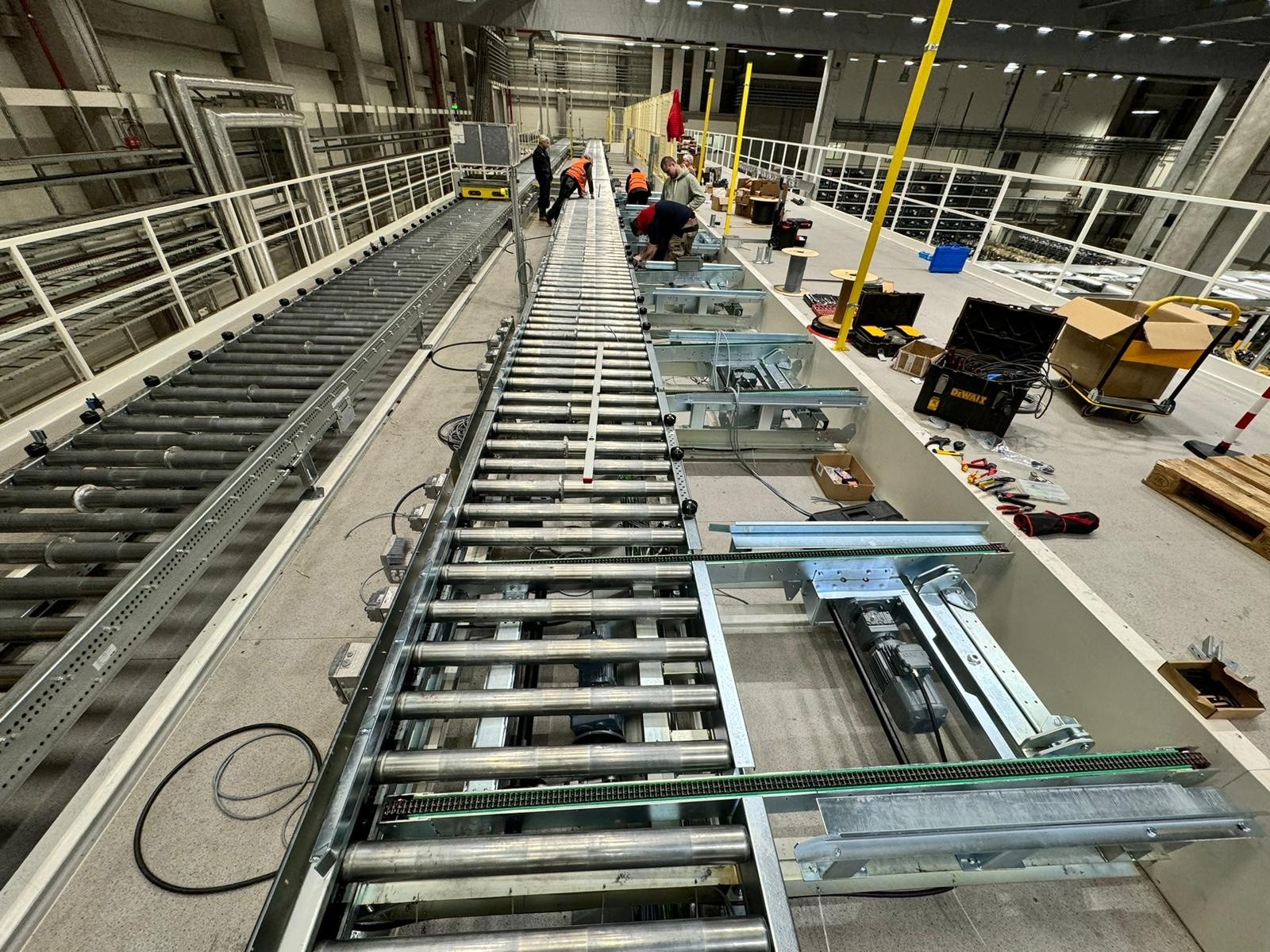
Unit-load handling may use roller or chain conveyors, transfers, turntables or connections between elevations. Design covers the product carrier, contact surfaces, drives, sensors and flow control. Parameters are established for the actual loads and layout.
Engineering priorities
Dimensions and underside condition influence support and roller spacing. Weight alone is insufficient: centre of gravity, carrier stiffness, overhangs and loading or unloading methods also matter.
A transverse transfer or turntable must deliver the carrier in the required position and match downstream availability. The design includes transfer conditions, positioning and the response when the next section is occupied.
Changes to an existing line require review of mechanics, drives, guarding and stopping functions. Higher speed can change both loading and risk. Acceptance therefore uses real products and agreed operating scenarios.
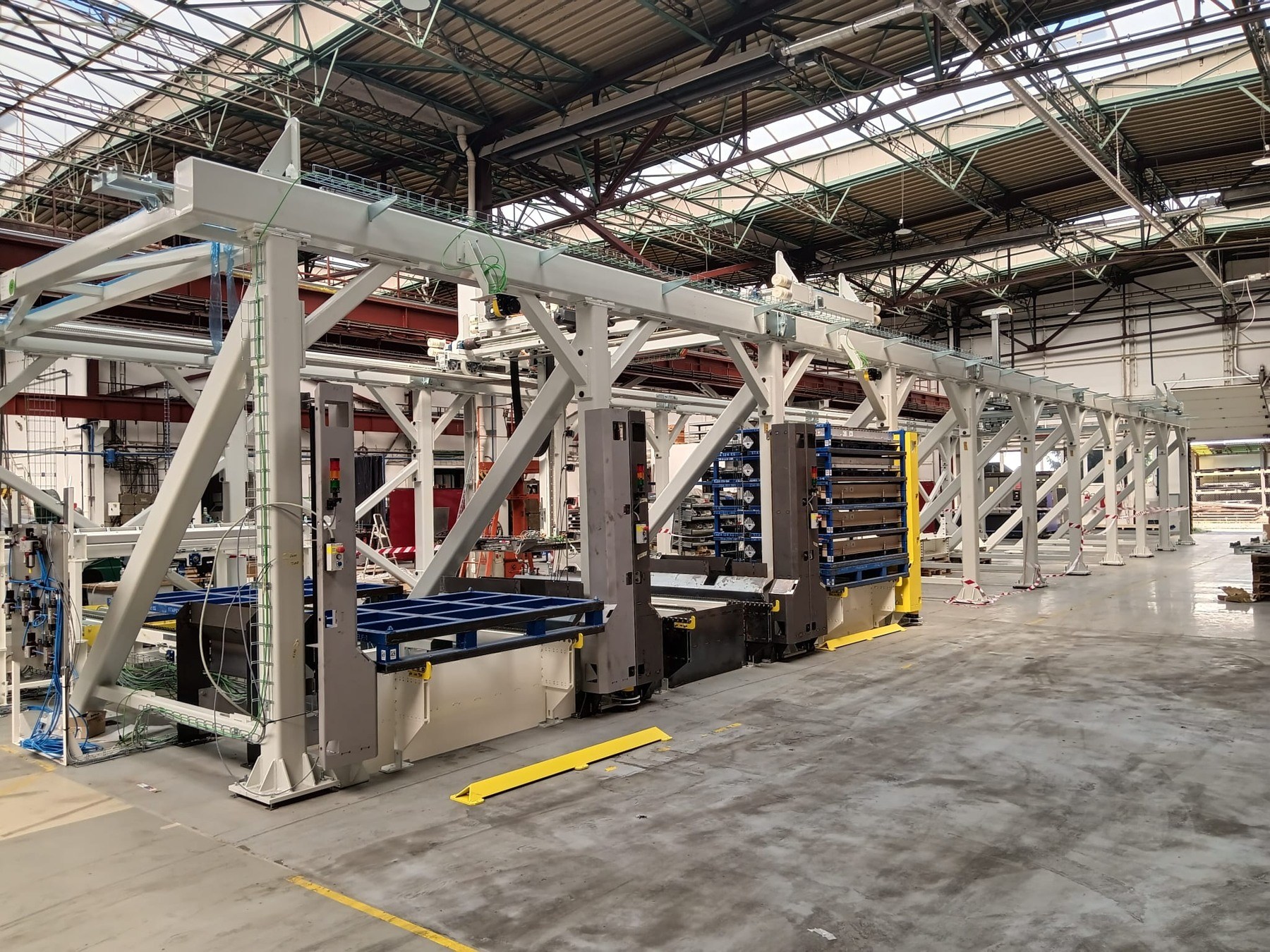
Overhead tracks, vertical transfers and lifting tables can connect workstations where floor space is limited. Assessment covers load capacity, load attachment, supporting-structure loads and protection against falling loads or trapping. Acceptance includes transfers between the individual sections.
Conveyors can interface with weighing, labelling, wrapping, strapping and empty-pallet magazines. The functional specification defines packing variants, product queues, rejection of non-conforming loads and data exchange with the warehouse system.
An indexing transfer, reciprocating transfer bar or robot gripper must coordinate with part loading and clamping. Design distinguishes the transport position from accurate location for the operation, and checks fixture release, return movement and space for variant changes.
Individually controlled zones maintain spacing between loads while they wait for the next operation. Zone length, occupancy detection and release logic are defined from load dimensions and the cycle of the downstream workstation.
Supply boundaries
Before engineering
Agreed with the proposal
The actual scope and acceptance criteria depend on the application and contract.
Selection in context
Acceptance testing, calibration, statutory inspection and conformity assessment serve different purposes, so agree their scope and expected documents before supply.
On a small screen, scroll the table sideways to compare the selection criteria.
| Principle or option | Typical application | What to agree and which output to expect |
|---|---|---|
| FAT: factory acceptance test | Verification of agreed functions and requirements before shipment, for example for a control system or assembly. | Approved procedure, criteria and simulated interfaces; the output records results, deviations and open items within the tested scope.[1] |
| SAT: site acceptance test | Verification after installation, considering actual connections and agreed operating conditions. | Site and utility readiness, interfaces and criteria; the output is a site test record and a list of outstanding actions.[1] |
| Calibration | Establishing the relationship between instrument indication and reference values under specified conditions. | Measurement points, traceability and uncertainty; the output reports calibration results, not adjustment or an automatic pass/fail decision.[2] |
| Statutory inspection, e.g. electrical equipment in Czechia | Assessment of equipment safety within the scope of applicable requirements. | Equipment type and extent, documentation and inspector qualification; the output is an inspection report with findings and a conclusion on the inspected condition.[3] |
| Product conformity assessment | Demonstrating compliance with applicable legal requirements before placing a product on the market or putting it into service. | Applicable legislation and procedure; the manufacturer prepares technical documentation and the relevant declaration, with notified-body involvement where the required procedure calls for it.[4] |
Reviewed on 18 October 2026. Selection is confirmed for the specific operating conditions and equipment design.
From technical proposal preparation
These examples describe proposed solutions and enquiry requirements. Their parameters belong to the stated project stage; completed supplies are shown separately in the project portfolio.
Design presented in 2025
A design for automated storage of battery cells with conveyor interfaces.
The concept combines controls, conveyors, racking and stacker cranes. The stated design scope includes the warehouse fire-safety concept.
An example of a completed engineering design. This project was not implemented. Parameters and the scope of a future supply will be defined for the specific application.
Discuss a similar application ↗Design presented in 2025
An engineering design for conveying products on trays.
The engineering views show the arrangement of a tray conveyor system. A future supply would require project-specific data on the carrier and product, load, operating cycle and adjacent equipment.
An example of a completed engineering design. This project was not implemented. Parameters and the scope of a future supply will be defined for the specific application.
Discuss a similar application ↗Design presented in 2025
An engineering design for a gantry manipulator handling wheel components.
The design shows the gantry arrangement of the handling station. A future supply would require the part geometry, gripping method, working envelope and required cycle to be specified.
An example of a completed engineering design. This project was not implemented. Parameters and the scope of a future supply will be defined for the specific application.
Discuss a similar application ↗Design presented in 2025
An example of a prepared palletising-station design.
The engineering concept addresses palletising. A future supply would define the product, pallet, stacking arrangement, handling equipment and interfaces with other workstations.
An example of a completed engineering design. This project was not implemented. Parameters and the scope of a future supply will be defined for the specific application.
Discuss a similar application ↗Relevant experience
Project 526 · Handling & automation
Installation location: Mladá Boleslav, Czechia · 2023–2025
Two gantry manipulators, conveyor interfaces and battery flow control for automotive production in Mladá Boleslav. The reference covers handed-over engineering and partial delivery stages.
Broader project portfolioEngineering and partial delivery stages
Project 572 · Handling & automation
Installation location: Kvasiny, Czechia · 2024
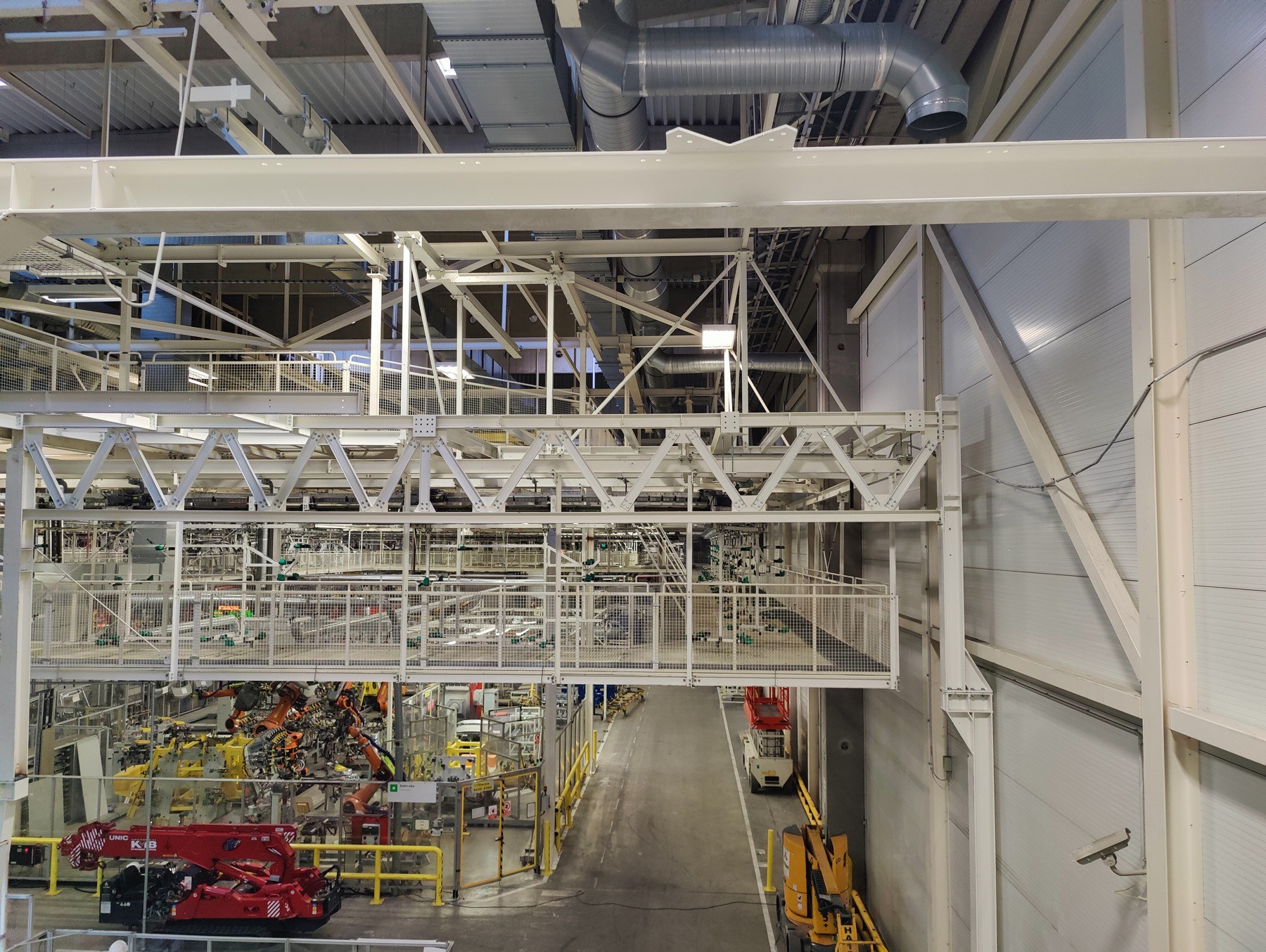
Engineering and supply of steel structures for an automotive conveyor route in Kvasiny. Three structural sections combine suspended, framed and trussed arrangements.
Broader project portfolioSteel structure and engineering
Project 422 · Handling & automation
Location: Mladá Boleslav, Czechia · 2023–2024
Mechanical transfer stations, cross transfers and new control functions for moving sequenced trolleys between production halls in Mladá Boleslav.
Broader project portfolioEngineering and delivery milestones
Connected disciplines
Related technologies
Before we start
Only if the drive is the real constraint. A transfer, manual operation or insufficient accumulation space may be the bottleneck instead.
After its condition, loading and compatibility are assessed. The interfaces between retained and new sections need defined mechanical and safety requirements.
Your next project
Send your drawings, operating parameters or a short description of the change you need. We will review the technical interfaces and propose the next steps towards a quotation, clarifying any missing information with you.
Discuss your requirements ↗Prepare a technical brief →+420 731 771 147info@emkoproject.cz